
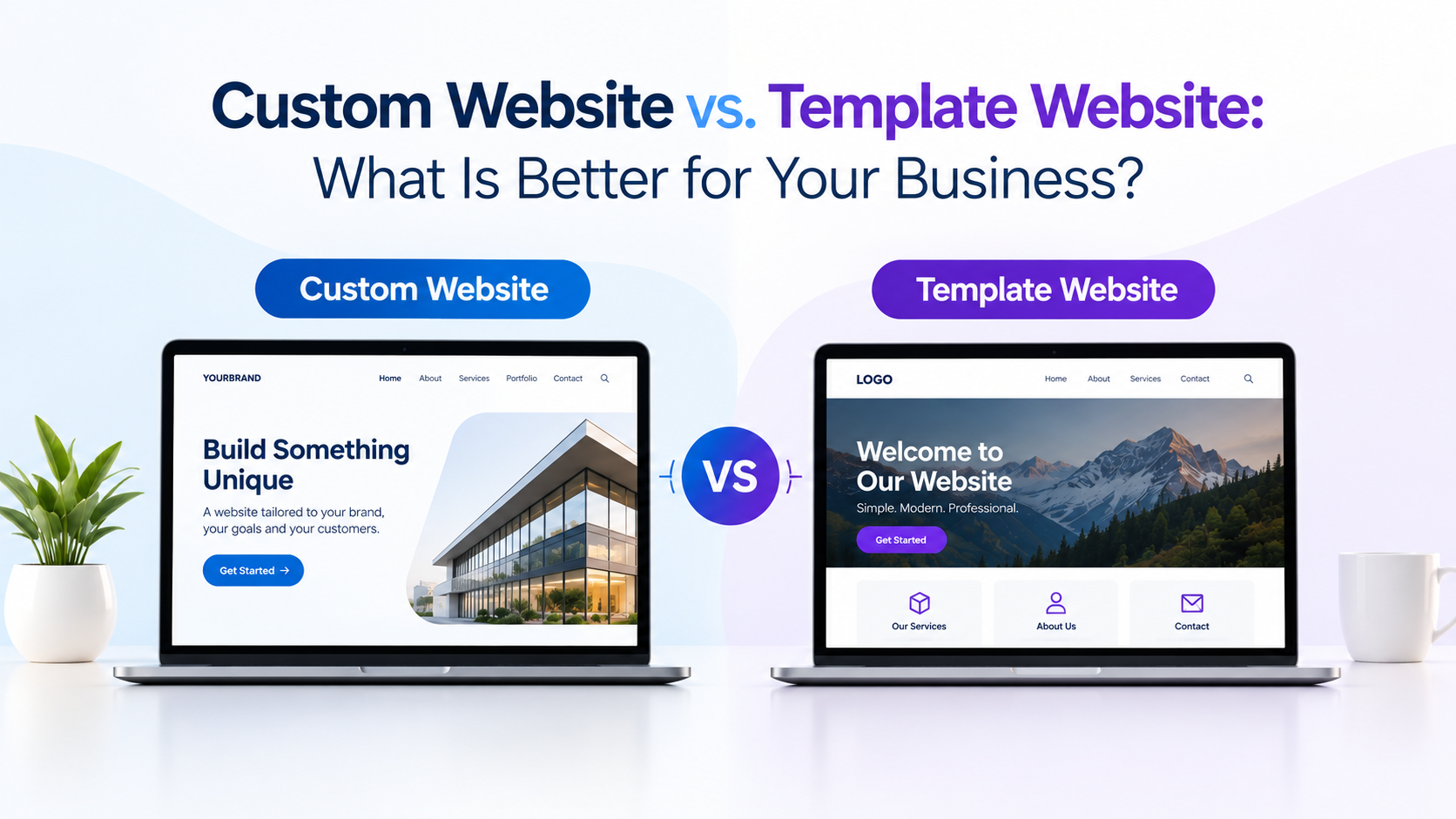
Custom Website vs. Template Website — which is better for your business? A template website can help a business launch quickly with a lower initial investment, while a custom website offers greater flexibility, unique design, scalability, performance control, and functionality.
The right choice depends on your business goals, target audience, budget, required features, scalability, brand positioning, SEO strategy, and long-term digital plans.
In today’s digital landscape, a website is more than an online brochure. It can be a sales channel, lead-generation platform, customer service touchpoint, eCommerce store, booking system, business application, or foundation for AI-powered search visibility.
This guide explains the differences between custom and template websites and helps businesses understand which approach fits their requirements.
Quick Answer: Custom Website or Template Website?
A template website is generally suitable for businesses that need a simple online presence quickly and have relatively standard requirements.
A custom website is more suitable for businesses that need a distinctive brand experience, custom functionality, advanced integrations, scalable architecture, stronger control over user experience, or long-term digital growth.
Neither option is universally better. The appropriate choice depends on what the website needs to accomplish.
What Is a Custom Website?
A custom website is designed and developed specifically for a business rather than being built around a pre-designed website template.
The design, page structure, functionality, user experience, integrations, content structure, and technical implementation can be planned around the organization’s specific requirements.
For example, a custom website may include:
- Unique UI/UX design
- Custom page layouts
- Business-specific workflows
- Custom forms and lead systems
- CRM integrations
- ERP integrations
- Payment gateway integration
- Booking and appointment systems
- Customer dashboards
- API integrations
- Advanced search and filtering
- Custom eCommerce functionality
- Membership systems
- AI-powered features
- Automation workflows
- Custom admin panels
- Scalable web applications
A custom website does not necessarily mean every line of code must be developed from zero. It means the overall website experience and functionality are planned around the business instead of being restricted primarily by a pre-built template.
What Is a Template Website?
A template website uses a pre-designed layout or theme that provides an established visual structure.
Businesses can customize elements such as:
- Logo
- Colors
- Typography
- Images
- Text
- Navigation
- Basic sections
- Some page layouts
Template-based websites are commonly available through platforms and CMS ecosystems such as WordPress and other website builders.
Templates can be useful when the business has straightforward requirements and wants to launch a website within a shorter timeframe.
However, the available customization can depend heavily on the selected theme, page builder, plugins, platform, and technical architecture.
Custom Website vs. Template Website: Key Differences
Factor | Custom Website | Template Website |
Design | Designed around the brand | Based on an existing design |
Brand differentiation | High | Usually limited |
Development time | Generally longer | Generally faster |
Initial cost | Usually higher | Usually lower |
Custom functionality | Highly flexible | Depends on template/platform |
Scalability | Can be planned for future requirements | May require workarounds |
Integrations | Can be developed around business needs | Depends on available integrations |
User experience | Fully customizable | Constrained by template structure |
Performance control | Greater technical control | Depends on theme, plugins and platform |
Maintenance | Depends on technology | Can be easier initially but may involve theme/plugin dependencies |
eCommerce flexibility | High | Depends on platform/theme |
SEO implementation | Can be structured from the beginning | Possible, but may depend on theme/plugin setup |
AI/AEO/GEO readiness | Can be incorporated into architecture and content | Possible with proper implementation |
Long-term flexibility | High | Moderate to limited depending on setup |
1. Design and Brand Identity
Your website is often one of the first places where potential customers experience your brand.
Custom Website
A custom website allows the design to be developed around your:
- Brand identity
- Target audience
- Business positioning
- Products and services
- Customer journey
- Conversion objectives
- Content strategy
This makes it possible to create a distinctive digital experience rather than adapting your brand to an existing layout.
Template Website
A template provides a predefined visual framework.
Although colors, fonts, images, and content can often be changed, the underlying structure may remain similar to other websites using the same template.
Why It Matters
If differentiation and premium brand perception are important, greater design control can be valuable.
For example, a technology company, consulting firm, luxury brand, SaaS company, or enterprise service provider may require a website experience that communicates its positioning more precisely.
2. Customization and Functionality
One of the biggest differences between custom and template websites is functionality.
A template generally works best when your requirements fit the features already provided by the theme or platform.
A custom website can be structured around specific business processes.
For example:
Customer → Website Form → CRM → Sales Team → Automated Follow-Up
Or:
Customer → Product Selection → Cart → Payment → Order Management → ERP
Or:
Dealer Login → OTP Verification → Invoice Lookup → Loyalty Points → Admin Approval → Rewards Wallet
These workflows may require custom development and integrations rather than simply installing a template.
3. Website Performance
Website performance affects user experience and can influence search visibility and conversions.
A template website can perform well when it is properly built and optimized. However, performance can become more complicated when a website relies on:
- Multiple plugins
- Heavy page builders
- Unused theme features
- Large media files
- Third-party scripts
- Poorly optimized code
- Excessive animations
- Multiple integrations
A custom website gives developers greater control over what is included in the architecture.
The objective should not simply be to build a custom website. The objective should be to build a fast, accessible, technically sound, and maintainable website.
4. SEO: Which Is Better?
Both custom and template websites can be optimized for SEO.
The important question is not simply whether a website is custom or template-based.
SEO depends on factors such as:
- Website architecture
- Crawlability
- Page speed
- Mobile usability
- Internal linking
- Heading structure
- Metadata
- Content quality
- Search intent
- Structured data
- Image optimization
- Canonicalization
- URL structure
- Technical SEO
- Backlinks and authority
- Local SEO where relevant
A custom website provides more control over the technical structure, but that does not automatically make it SEO-friendly.
Similarly, a well-configured template website can perform effectively when its technical and content SEO are properly implemented.
5. AEO, GEO and AI Search Readiness
Search is increasingly moving beyond traditional blue-link results.
Users may discover businesses through:
- Search engines
- AI-powered search
- Conversational assistants
- Answer engines
- Local search
- Voice interfaces
- Generative search experiences
This makes content structure increasingly important.
What Is AEO?
AEO (Answer Engine Optimization) focuses on structuring content so that search and answer systems can understand and potentially use it when responding to user questions.
Useful elements include:
- Direct answers
- FAQs
- Clear headings
- Question-based content
- Structured information
- Definitions
- Supporting context
- Schema markup where appropriate
What Is GEO?
GEO (Generative Engine Optimization) focuses on improving how a brand’s content can be understood, retrieved, and represented within generative AI search experiences.
Important foundations include:
- Clear and authoritative content
- Consistent business information
- Well-structured pages
- Relevant topical coverage
- Strong entity relationships
- Supporting evidence and references
- Helpful FAQs
- Structured data where applicable
Can Template Websites Support AEO and GEO?
Yes.
A template website can be structured for SEO, AEO and GEO when the platform allows appropriate control over content, technical implementation, structured data, performance and page architecture.
A custom website can provide greater control over these elements, particularly when advanced content architecture or custom functionality is required.
Important: No website structure can guarantee rankings or inclusion in AI-generated answers. Search and AI systems use many signals, and their algorithms continuously evolve.
6. Scalability
A website that works today may not meet your requirements two or three years from now.
A business may eventually want:
- New service pages
- Multiple locations
- eCommerce
- Customer accounts
- Subscription plans
- CRM integration
- ERP integration
- Marketing automation
- AI assistants
- Advanced analytics
- Partner portals
- Dealer portals
- Mobile applications
- Custom dashboards
A custom website can be architected with these future requirements in mind.
Template websites can also grow, but eventually businesses may encounter limitations imposed by the selected theme, platform, plugins, or existing architecture.
7. Security and Maintenance
Security is important for every website, regardless of whether it is custom or template-based.
Template-based websites may depend on third-party:
- Themes
- Plugins
- Extensions
- Page builders
- Integrations
These components need to be maintained and updated.
Custom websites also require ongoing security practices, including:
- Software updates
- Dependency management
- Secure authentication
- Access control
- Backup systems
- Vulnerability monitoring
- Server security
- Secure API integration
The technology stack and development practices matter more than simply choosing “custom” or “template.”
8. Development Time
Template Website
A template website can generally be launched faster because the basic design and functionality already exist.
This can be useful for:
- New businesses
- Simple company websites
- Landing pages
- Small portfolios
- Basic informational websites
Custom Website
Custom design and development generally require more planning.
A typical custom website process may include:
Requirement Gathering → Sitemap → UX Planning → Prototype → UI Design → Development → Content Integration → Testing → SEO Setup → Launch
The additional planning can increase development time, but it can also provide greater control over the final experience.
9. Initial Cost vs. Long-Term Value
Template websites generally have a lower entry cost because the underlying design and functionality already exist.
Custom websites typically require more investment because they involve more design, development, testing and planning.
However, comparing only the initial price can be misleading.
Businesses should also consider:
- Future modifications
- Plugin or theme costs
- Licensing
- Maintenance
- Scalability
- Integration requirements
- Performance optimization
- Rebuilding costs
- Business growth
The better question is:
What level of website investment is appropriate for the business objectives and expected lifespan of the website?
10. User Experience and Conversion Optimization
A website should not only look attractive. It should help visitors take meaningful actions.
Depending on the business, these actions could include:
- Requesting a quote
- Booking an appointment
- Calling the business
- Sending an enquiry
- Purchasing a product
- Downloading a resource
- Registering for an account
- Starting a subscription
- Contacting sales
With a custom website, user journeys can be designed specifically around these conversion objectives.
Template websites can also be optimized for conversions, but the available layout and interaction patterns may place constraints on the experience.
Custom vs. Template: Which Businesses Typically Need What?
Business Requirement | Commonly Suitable Approach |
Simple company profile | Template or custom |
Startup MVP | Template or custom |
Basic portfolio | Template |
Local service business | Template or custom |
Professional services | Custom or customized template |
Premium brand | Custom |
Enterprise website | Custom |
Complex eCommerce | Custom or highly customized platform |
SaaS company | Custom |
CRM-integrated website | Custom |
ERP-integrated website | Custom |
Dealer/customer portal | Custom |
Complex booking system | Custom |
AI-powered business application | Custom |
Simple landing page | Template |
These are general considerations, not strict rules. The right choice depends on the actual requirements.
When Should You Choose a Template Website?
A template website may make sense when:
- You need to launch quickly.
- Your requirements are relatively simple.
- You have a limited initial budget.
- Standard layouts are sufficient.
- You do not need complex integrations.
- Your business does not require highly differentiated functionality.
- You need a temporary MVP or initial online presence.
For some businesses, a well-configured template can be a practical starting point.
When Should You Choose a Custom Website?
A custom website may be appropriate when:
- Your brand requires a unique digital identity.
- You have specific business workflows.
- You require custom integrations.
- You expect significant future growth.
- You need advanced functionality.
- Your website is an important lead-generation channel.
- You need custom eCommerce functionality.
- You require CRM or ERP integration.
- You want customer or dealer portals.
- You need advanced filtering or search.
- Your website needs to support a complex customer journey.
- You want greater control over the technical architecture.
Common Mistakes Businesses Make When Choosing a Website
1. Choosing Only Based on Price
The cheapest website may not always be the most cost-effective option over its entire lifecycle.
Consider the total cost of ownership rather than only the initial development price.
2. Choosing a Template Because It Looks Good in the Demo
A template demo may look impressive, but businesses should check whether its:
- Structure
- Navigation
- Performance
- Content model
- Functionality
- Mobile experience
actually match their requirements.
3. Assuming Custom Means Automatically Better SEO
Custom development provides flexibility, but poor technical implementation can still result in SEO problems.
4. Ignoring Future Requirements
Before development starts, consider what the business may need later.
A website should not necessarily be over-engineered, but its architecture should avoid unnecessary limitations.
5. Focusing Only on Visual Design
A successful website combines:
Design + Content + UX + Performance + SEO + Accessibility + Security + Conversion Strategy
How to Choose the Right Website Approach
Before selecting custom or template development, answer these questions:
1. What is the primary purpose of the website?
Is it primarily for:
- Branding?
- Lead generation?
- eCommerce?
- Bookings?
- Customer support?
- SaaS?
- Business automation?
2. How unique are your requirements?
If your requirements are standard, a template may be sufficient.
If your workflows are unique, custom development may be more appropriate.
3. How important is brand differentiation?
If the website is a major part of your brand experience, greater design control can be valuable.
4. Will the website need integrations?
Consider:
- CRM
- ERP
- Payment gateways
- Shipping
- Marketing automation
- Analytics
- APIs
- AI tools
- Third-party platforms
5. What will the website need in the future?
Think beyond launch day.
A good website decision should consider the next stage of business growth.
A Practical Decision Framework
You can use the following framework:
Choose a Template Approach If:
Simple Requirements + Faster Launch + Lower Initial Investment = Template
Consider Custom Development If:
Unique Requirements + Strong Branding + Custom Functionality + Scalability = Custom
Consider a Hybrid Approach If:
Standard CMS Foundation + Custom Design/Development = Customized Website
A hybrid approach can sometimes provide a balance between flexibility, development speed and cost.
Custom Website vs. Template Website: The Real Difference
The real difference is not simply “custom is expensive” and “templates are cheap.”
The deeper difference is control.
A template starts with an existing structure and asks:
“How can we adapt our business to this framework?”
A custom website starts with the business requirements and asks:
“How should the website be designed and built to support the business?”
Neither approach is inherently right for every company.
The right solution depends on your goals, complexity, budget, timeline and long-term digital strategy.
How Waytowebs Approaches Website Development
At Waytowebs, we focus on developing websites around business requirements rather than simply fitting businesses into generic layouts.
Our website development approach can include:
- Custom UI/UX design
- Responsive web design
- Business-focused information architecture
- WordPress development
- eCommerce development
- WooCommerce development
- Shopify development
- Web application development
- CRM integration
- ERP integration
- API integrations
- SEO-friendly architecture
- AEO-ready content structures
- AI-search-friendly content organization
- Performance optimization
- Conversion-focused user journeys
The objective is to create a website that supports the business today while allowing room for future growth.
No two businesses have exactly the same requirements. Your website should reflect that.
Frequently Asked Questions
Is a custom website better than a template website?
A custom website provides greater control over design, functionality, user experience and scalability. A template website can be a practical option for businesses with straightforward requirements, faster launch expectations or lower initial budgets. The appropriate choice depends on the business requirements.
Is a template website good for SEO?
Yes. A template website can be SEO-friendly when it has a technically sound structure, optimized content, good performance, mobile usability, proper metadata, internal linking, structured data where appropriate and other essential SEO elements.
Are custom websites more expensive?
Custom websites generally require more design and development work, so their initial cost can be higher than a template-based website. However, total cost should also consider future customization, maintenance, integrations, licensing and scalability.
How long does it take to build a custom website?
The timeline depends on the number of pages, design complexity, functionality, content readiness, integrations and testing requirements. A simple custom website can take significantly less time than a complex website application or eCommerce platform.
Can a template website be customized?
Yes. Many templates allow customization of colors, fonts, layouts, sections and functionality. The level of customization depends on the theme, CMS, page builder and platform.
Can a custom website use WordPress?
Yes. Custom website design and WordPress are not mutually exclusive. A WordPress website can have a custom-designed interface and custom functionality while using WordPress as its content management system.
Is a custom website better for AI search?
A custom website can provide greater control over technical architecture and content structure, but custom development alone does not guarantee visibility in AI-generated search results. AI search visibility depends on multiple factors, including content quality, structure, authority, relevance and how search systems retrieve and interpret information.
What is better for a startup: custom or template?
The answer depends on the startup’s stage and requirements. A template can help launch a straightforward website quickly, while a custom website may be appropriate when the startup needs a differentiated brand experience, custom workflows, integrations or a scalable digital product.
Can I start with a template and later move to a custom website?
Yes. However, businesses should consider whether the initial architecture will make future migration difficult. If custom functionality is expected soon, planning the technical foundation early can reduce redevelopment effort later.
Final Takeaway
Custom vs. template is not simply a question of which website is better. It is a question of which website approach is better aligned with your business.
A template can provide speed, simplicity and a lower entry point.
A custom website can provide greater control, differentiation, functionality and scalability.
Before making a decision, evaluate:
Business Goals → Website Requirements → Customer Journey → Design Needs → Functionality → Integrations → SEO → AI Search Readiness → Scalability → Budget → Long-Term Maintenance
The best website is the one that effectively supports your business objectives, customer needs and future digital strategy.
Build a Website Around Your Business
If your business needs more than a standard layout, Waytowebs can help plan and develop a custom website, eCommerce platform, web application or business-focused digital solution based on your requirements.
Waytowebs — Custom Digital Solutions Designed Around Your Business.