
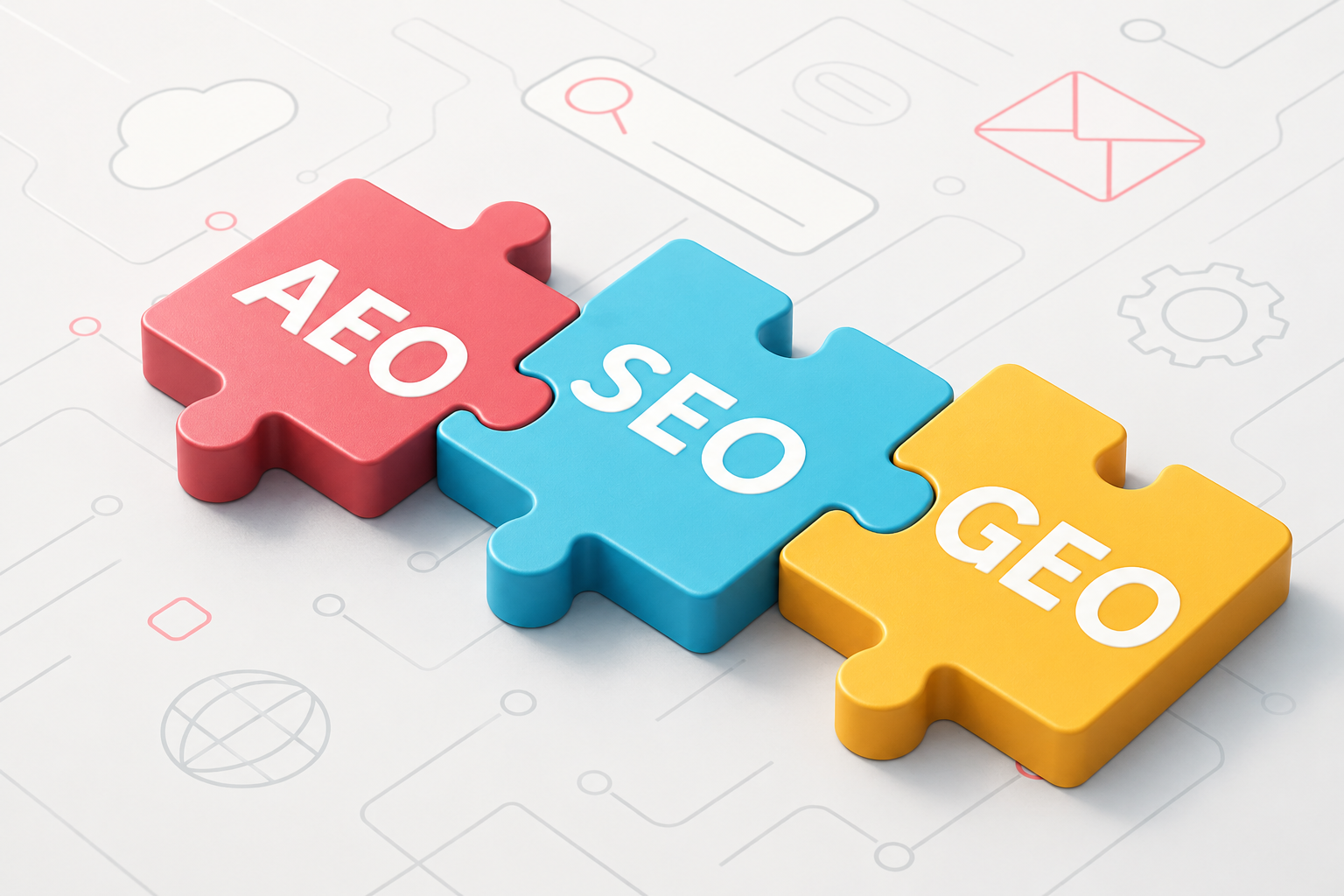
For years, businesses focused primarily on Search Engine Optimization (SEO) to improve their visibility on Google and other traditional search engines. Today, users are increasingly searching through conversational interfaces, AI-powered search experiences, voice assistants, and answer engines.
This shift has introduced two important concepts: Answer Engine Optimization (AEO) and Generative Engine Optimization (GEO).
While SEO, AEO, and GEO overlap, they are not exactly the same. Each addresses a different way users discover, evaluate, and interact with information online.
For businesses building a website or digital marketing strategy in 2026, understanding the difference between SEO vs. AEO vs. GEO can help create a stronger and more sustainable search visibility strategy.
In this guide, we explain what SEO, AEO, and GEO mean, how they differ, how they work together, and how businesses can prepare their websites for both traditional search engines and AI-powered search.
What Is SEO?
SEO, or Search Engine Optimization, is the process of improving a website’s visibility in traditional search engine results.
Search engines such as Google use numerous signals to understand webpages, determine relevance, evaluate quality, and rank results for users’ queries.
A strong SEO strategy typically includes:
- Keyword research
- Search intent optimization
- Technical SEO
- On-page SEO
- Content optimization
- Internal linking
- Website performance
- Mobile usability
- Structured data
- Backlinks and digital authority
- Local SEO
- Helpful and trustworthy content
For example, a web development company targeting the keyword “web development company in USA” may create a dedicated service page optimized around that search intent.
What Is the Goal of SEO?
The primary goal of SEO is to help search engines:
- Discover your website.
- Crawl and understand your content.
- Determine its relevance and quality.
- Match your pages with relevant search queries.
- Display your content prominently when appropriate.
SEO therefore remains an important foundation for digital visibility.
What Is AEO?
AEO, or Answer Engine Optimization, focuses on structuring content so that search engines and answer engines can easily identify and provide direct answers to users’ questions.
Instead of only targeting traditional keyword-based searches, AEO focuses on question-based and conversational search intent.
For example, instead of searching:
“CRM software”
a user may ask:
“What is the difference between CRM and ERP?”
An AEO-friendly page should provide a clear, concise answer to that question and then offer supporting information.
Common AEO Content Formats
AEO often benefits from content such as:
- Frequently Asked Questions
- Direct answers
- Definitions
- Step-by-step explanations
- Comparison tables
- How-to content
- Lists
- Troubleshooting guides
- Conversational question-and-answer sections
- Structured data
For example:
Question: What is CRM?
Answer: CRM, or Customer Relationship Management, is a system businesses use to manage customer information, interactions, sales activities, leads, and customer relationships from a centralized platform.
This format makes the information easier for search systems and users to understand.
What Is GEO?
GEO, or Generative Engine Optimization, focuses on improving the likelihood that a business, website, product, service, or piece of content is accurately represented and referenced within AI-generated search experiences.
AI-powered search experiences increasingly synthesize information from multiple sources rather than simply presenting a traditional list of blue links.
Users may ask questions such as:
“What should I look for when choosing a web development company?”
or:
“Which technologies are commonly used to build scalable business applications?”
An AI-generated response may synthesize information from several webpages.
This creates a new visibility opportunity for businesses: being discoverable and accurately represented within AI-generated answers.
GEO Focuses on More Than Keywords
A GEO strategy can involve:
- Clear and authoritative content
- Well-structured information
- Entity clarity
- Strong topical relevance
- First-hand expertise
- Supporting evidence
- Original insights
- Frequently asked questions
- Clear definitions
- Structured data
- Author and company information
- Consistent business information
- Relevant external references
- Content that is easy for machines to interpret
GEO should not be treated as a guaranteed way to make an AI system mention a particular company. AI-generated results depend on the system, query, sources, retrieval processes, and other factors.
SEO vs. AEO vs. GEO: What’s the Difference?
The easiest way to understand the three concepts is to look at their primary focus.
Area | SEO | AEO | GEO |
Full Form | Search Engine Optimization | Answer Engine Optimization | Generative Engine Optimization |
Primary Focus | Search visibility | Direct answers | AI-generated visibility |
Main Experience | Search results | Questions and answers | AI-generated responses |
Content Priority | Relevant, useful content | Clear, concise answers | Authoritative, contextual information |
Common Optimization | Keywords, technical SEO, links | FAQs, structured answers, schema | Entity clarity, expertise, context, citations |
Search Intent | Informational, commercial, transactional, navigational | Primarily question-driven | Conversational and complex queries |
Key Opportunity | Rankings and organic traffic | Featured answers and answer visibility | Inclusion or accurate representation in AI responses |
These approaches are different, but they should not be treated as three completely separate marketing strategies.
A modern website can be designed to support all three.
SEO, AEO and GEO Work Together
One of the biggest misconceptions is that businesses need to choose between SEO, AEO, and GEO.
In reality, they can form a connected search visibility framework.
Think of it as:
SEO → Discoverability
AEO → Answerability
GEO → AI Visibility
A technically strong website helps search systems discover and understand your pages.
Well-structured answers make your information easier to extract and present.
Authoritative, contextual content gives AI-powered systems more useful information from which to construct responses.
Therefore, businesses should think beyond:
“How do I rank for this keyword?”
and consider:
“How can I make my business information easy for search engines, answer engines, users, and AI systems to understand?”
Why Traditional SEO Alone Is No Longer Enough
SEO remains essential, but the search ecosystem is becoming more conversational and multimodal.
Users increasingly interact with search through:
- Conversational queries
- Voice search
- AI assistants
- AI-powered search interfaces
- Long-form questions
- Follow-up questions
- Comparison searches
- Product research
- Local discovery
A user may begin with a broad query and then ask several follow-up questions.
For example:
Query 1:
“What is CRM software?”
Query 2:
“How does CRM help sales teams?”
Query 3:
“CRM vs ERP—which one does a growing business need?”
Query 4:
“What features should I look for?”
A website that answers the entire topic comprehensively has more opportunities to demonstrate relevance than a page targeting only one keyword.
How to Make a Website SEO, AEO and GEO Friendly
A strong strategy starts with the website itself.
1. Build a Strong Technical SEO Foundation
Before focusing on AI search, make sure search engines can properly access and understand your website.
Important areas include:
- Crawlability
- Indexability
- XML sitemap
- Robots.txt
- Canonical URLs
- HTTPS
- Mobile responsiveness
- Core Web Vitals
- Page speed
- Clean URL structure
- Internal linking
- Image optimization
- Proper redirects
- Structured data
Technical problems can prevent high-quality content from reaching users regardless of how well it is written.
2. Create Content Around Search Intent
Don’t create content simply because a keyword has search volume.
Understand why the user is searching.
For example:
Keyword: “CRM development”
Possible search intents include:
- What is CRM development?
- How much does custom CRM development cost?
- How does CRM development work?
- Custom CRM vs ready-made CRM
- CRM features for businesses
- How long does CRM development take?
A comprehensive content strategy can address these related questions naturally.
3. Use Clear Questions and Direct Answers
This is particularly useful for AEO.
Instead of writing large blocks of text, structure relevant sections around questions.
Example
What is custom CRM development?
Custom CRM development is the process of designing and developing a CRM platform specifically around a business’s workflows, customer management requirements, integrations, reporting needs, and operational processes.
The detailed explanation can follow the direct answer.
This structure improves readability for humans while making the information easier to interpret programmatically.
4. Use Structured Data Where Appropriate
Structured data helps search engines understand specific information on a webpage.
Depending on the content, businesses may use appropriate schema types such as:
- Organization
- LocalBusiness
- Product
- Service
- Article
- BreadcrumbList
- FAQPage, where appropriate
- Review
- Event
- SoftwareApplication
Structured data should accurately represent visible page content and follow the relevant search engine guidelines.
It is not a shortcut to guaranteed rankings or AI visibility.
5. Build Topic Clusters
Instead of publishing isolated articles, create a connected content ecosystem.
For example, a technology company could create a central topic:
CRM Solutions
Then support it with related content:
- What Is CRM?
- CRM vs ERP
- Custom CRM vs Off-the-Shelf CRM
- CRM Automation Guide
- CRM Integration With Accounting Software
- CRM Features for Growing Businesses
- How Much Does Custom CRM Development Cost?
- CRM Implementation Guide
- Common CRM Development Mistakes
These pages can be internally linked to one another.
This helps establish topical depth and gives search systems more context about the company’s expertise.
6. Strengthen Business and Entity Information
GEO makes entity clarity increasingly important.
Your website should clearly communicate:
- Who your company is
- What services you provide
- Where you operate
- What industries you serve
- What technologies you use
- Who your team is
- What experience you have
- What projects or solutions you offer
- How users can contact you
For example, instead of repeatedly mentioning generic phrases such as “the best company,” provide specific information about your company, services, processes, expertise, and experience.
Specific information is more useful than exaggerated claims.
7. Demonstrate First-Hand Expertise
Modern search content should provide more than generic information that could have been generated from dozens of existing articles.
Businesses can strengthen content with:
- Original examples
- Case studies
- Project experiences
- Implementation considerations
- Industry-specific insights
- Expert commentary
- Original research
- Data
- Practical workflows
- Lessons learned
- Real-world scenarios
For example, a web development company can explain not only what Next.js is, but also when a business application may benefit from Next.js, what architectural considerations matter, and how the technology fits into a broader development strategy.
8. Make Content Easy for AI Systems to Understand
AI-friendly content does not mean writing specifically for machines at the expense of people.
Instead, create content with a clear information architecture.
Use:
Clear headings – Break large topics into logical sections.
Short paragraphs – Keep individual ideas easy to understand.
Definitions – Clearly explain technical terminology.
Lists – Use bullet points when multiple items need to be presented.
Tables – Use comparison tables when information has multiple dimensions.
FAQs – Answer genuine questions users may ask.
Context – Don’t mention an entity or technology without explaining what it is and why it matters.
9. Optimize for Conversational Search
People don’t always search using short keywords.
They increasingly use complete questions.
Instead of:
“eCommerce website development”
users may search:
“How much does it cost to build an eCommerce website?”
or:
“What features should an eCommerce website have?”
Your content should naturally cover both short-form keywords and longer conversational questions.
10. Build Trust Across the Web
Your website is not the only source of information about your business.
Search engines and AI systems may encounter your business through:
- Business directories
- Industry websites
- Review platforms
- Social profiles
- News coverage
- Professional publications
- Partner websites
- Portfolio platforms
- Business listings
Maintain consistent business information across relevant platforms.
For local businesses, this can include consistent:
- Business name
- Address
- Phone number
- Website
- Services
- Business category
Consistency helps reduce ambiguity around your business entity.
The Role of E-E-A-T in Modern Search
Google’s guidance emphasizes Experience, Expertise, Authoritativeness, and Trustworthiness (E-E-A-T) as important concepts for evaluating content quality.
Businesses should therefore consider:
Experience
Can you demonstrate real experience with the subject?
Expertise
Does the content demonstrate relevant knowledge?
Authoritativeness
Is the business or author recognized as a credible source?
Trustworthiness
Is the information accurate, transparent, and supported appropriately?
For businesses, this can be reinforced through author information, company information, case studies, references, credentials, project examples, and transparent claims.
SEO vs. AEO vs. GEO: Which One Should Your Business Focus On?
Rather than selecting one, businesses should consider their objectives.
If your primary goal is organic search traffic
Build a strong SEO foundation.
Focus on:
- Technical SEO
- Search intent
- Keyword strategy
- Content
- Internal linking
- Authority
- Local SEO where relevant
If your goal is answering customer questions
Strengthen AEO.
Focus on:
- FAQs
- Question-based content
- Direct answers
- Definitions
- Structured information
- Conversational queries
If your goal is improving visibility in AI-powered search
Develop a GEO-oriented content strategy.
Focus on:
- Entity clarity
- Topical authority
- First-hand expertise
- Original content
- Clear context
- Structured information
- Trust signals
- Consistent business information
In practice, these strategies can operate together.
Common SEO, AEO and GEO Mistakes Businesses Should Avoid
1. Keyword Stuffing
Repeating a keyword excessively does not create useful content.
Write naturally around the topic and search intent.
2. Creating Content Only for AI
AI-friendly content should still be useful to humans.
Don’t sacrifice readability for perceived machine optimization.
3. Publishing Generic AI-Generated Articles
AI tools can assist with content creation, but publishing repetitive, inaccurate, or generic content without human review can weaken content quality.
4. Making Unsupported Claims
Statements such as:
“We are the #1 web development company”
are less useful than specific evidence such as:
“We provide custom web design, development, eCommerce, SaaS, CRM, and digital solutions for businesses across multiple markets.”
Specificity creates clearer context.
5. Ignoring Technical SEO
Excellent content cannot compensate for serious crawlability, indexability, performance, or website architecture problems.
6. Treating Schema as a Ranking Shortcut
Structured data helps search engines understand content, but implementation does not guarantee enhanced search results, rankings, or AI citations.
7. Creating Separate Content for Every Minor Keyword
A large volume of thin pages can create unnecessary duplication.
Focus on comprehensive resources that genuinely satisfy user intent.
How Businesses Can Build an SEO + AEO + GEO Strategy
A practical implementation framework can look like this:
Step 1: Audit the Website
Review:
- Technical SEO
- Existing content
- Search visibility
- Page structure
- Internal linking
- Schema
- Business information
- Performance
Step 2: Identify Search Intent
Map informational, commercial, transactional, navigational, and conversational queries.
Step 3: Build Topic Clusters
Create core service pages supported by detailed educational content.
Step 4: Add Question-Based Content
Identify real customer questions and answer them clearly.
Step 5: Improve Content Depth
Add examples, use cases, processes, comparisons, original insights, and supporting information.
Step 6: Strengthen Entity Signals
Clearly define the company, services, locations, industries, technologies, and expertise.
Step 7: Implement Structured Data
Use relevant structured data accurately and consistently.
Step 8: Build Digital Authority
Develop credible mentions, references, partnerships, listings, PR, and other relevant off-page signals.
Step 9: Monitor Search Visibility
Track traditional search performance alongside emerging AI-search visibility where measurable.
Step 10: Continuously Update Content
Search behavior and AI-powered search experiences continue to evolve. Content should therefore be reviewed and updated rather than treated as a one-time project.
What Does an AI-Friendly Website Look Like?
An AI-friendly website is not simply a website filled with AI-generated content.
It is a website where information is:
Clear → Structured → Relevant → Contextual → Accurate → Accessible → Trustworthy
For example, a strong service page should clearly communicate:
What is the service?
Who is it for?
What problems does it solve?
What features or deliverables are included?
How does the process work?
What technologies or methodologies are used?
What questions do customers commonly ask?
How can the customer get started?
This creates a better experience for both people and information-retrieval systems.
The Future of Search: From Rankings to Answers and Recommendations
Search is moving from a simple model of:
Query → Search Results → Website
toward increasingly conversational experiences such as:
Question → AI/Search System → Synthesized Information → Sources → Follow-up Questions
This does not mean traditional SEO is disappearing.
Instead, businesses need to consider a broader digital visibility ecosystem.
A website should be discoverable through traditional search, provide direct answers to important questions, and communicate enough authoritative context to be useful in AI-powered search experiences.
SEO + AEO + GEO: A Practical Framework for 2026
For businesses, the modern approach can be summarized as:
SEO
Be discoverable.
Make your website technically sound, relevant, useful, and accessible to search engines.
AEO
Be answerable.
Structure important information so users and answer engines can quickly understand the answer to a question.
GEO
Be understandable and referenceable in generative search.
Build authoritative, contextual, well-structured information that clearly represents your business and expertise.
Together:
SEO helps people find you. AEO helps answer their questions. GEO helps your information participate in AI-driven discovery experiences.
Frequently Asked Questions
Is SEO still important with AI search?
Yes. Traditional search engines continue to play an important role in online discovery. SEO also provides the technical and content foundation needed for broader search visibility.
Is AEO the same as SEO?
No. AEO focuses more specifically on providing direct, structured answers to user questions, while SEO covers the broader process of improving organic search visibility.
Is GEO the same as AEO?
No. AEO primarily focuses on answer-oriented search experiences, while GEO focuses on visibility and representation within generative AI search experiences.
Can SEO, AEO and GEO be implemented together?
Yes. They can be integrated into one broader search visibility strategy. Technical SEO, high-quality content, structured information, question-based answers, entity clarity, and authoritative resources can support multiple search experiences.
Does GEO guarantee that ChatGPT or another AI will mention my company?
No. There is no reliable guarantee that an AI system will mention, cite, recommend, or rank a particular company. AI-generated results depend on the system, query, available sources, retrieval mechanisms, and other factors.
Does adding FAQ schema guarantee AEO visibility?
No. Structured data can help search engines understand content, but it does not guarantee featured answers, rich results, or AI visibility.
Should businesses create separate pages for SEO, AEO and GEO?
Not necessarily. A well-planned page can address traditional search intent, answer common questions, and provide structured, authoritative information simultaneously.
How often should SEO, AEO and GEO content be updated?
There is no universal schedule. Review content based on changes in the industry, search behavior, business offerings, technology, regulations, and the accuracy or usefulness of the information.
Final Thoughts
The future of search is not simply about ranking for more keywords.
Businesses need to make their information discoverable, understandable, useful, and trustworthy across multiple search experiences.
SEO, AEO, and GEO represent different aspects of this evolving environment.
A strong digital strategy should therefore focus on:
Technical foundation + Search intent + Helpful content + Direct answers + Structured information + Entity clarity + Expertise + Trust
At Waytowebs, we help businesses build websites and digital solutions with modern search visibility in mind—from Web Design and Web Development to eCommerce, CRM, ERP, SaaS, AI Automation, UI/UX, and Digital Marketing.
A website should not only look professional. It should be structured to communicate clearly with users, search engines, answer engines, and emerging AI-powered discovery platforms.
Want to build a website prepared for modern search? Talk to Waytowebs about your next digital project.